






HAIs
Latest News
Advertisement
Latest Videos




Shorts

0:43
Announcing Contagious Conversations: ICT's New Program on the Science, People, and Dynamics of IPC Today
3 days ago

0:35
The Bacteria That Cuts Through Tissue Like a Laser
10 days ago

1:01
The Most Important Day of a Patient’s Life Starts With Education and Infection Prevention
10 days ago

0:50
When Gloves Were Considered Insulting to Patients
a month ago
1:15
Why 'Gotcha' Moments Don't Work in Health Care
a month ago

1:23
Burnout, Value, and the Case for Seeing IPs as an Investment
3 months ago
by
Tori Whitacre Martonicz

1:22
Hidden Hazards: Why Hospital Sink Drains Are a Biofilm Breeding Ground
3 months ago
by
Tori Whitacre Martonicz

0:52
Unsung Heroes: Elevating EVS as Full Partners in Infection Prevention
3 months ago
by
Tori Whitacre Martonicz

1:22
Far-UVC: Clean Air for All, Not Just a Privilege
3 months ago
by
Tori Whitacre Martonicz
CME Content

Advertisement
More News
Infection prevention professionals are facing a critical breaking point. New survey data reveal widespread understaffing, rising burnout, and systemic undervaluation that threaten patient safety, outbreak readiness, and health system resilience.



Carbapenemase-producing Enterobacterales (CPE) are increasing nationwide, with harder-to-treat NDM strains reshaping the resistance landscape. In this Q&A, Lucas Schulz, PharmD, explains why rapid diagnostics and stewardship are critical to protecting patients and preserving last-line antibiotics.

In this physician-authored analysis, a December 2025 CMS policy change ending mandatory childhood vaccine reporting is examined through a clinical and public health lens. The article warns that reduced surveillance, weakened federal recommendations, and increased reliance on shared decision making without clinical equipoise could accelerate declining vaccination rates, undermine outbreak response, and leave families without clear, evidence-based guidance.

A recent CMS policy change means states will no longer be required to report childhood vaccination data, raising serious concerns for infection prevention and control professionals. Without reliable immunization reporting, IPC teams may lose critical visibility into vaccine coverage, complicating outbreak prevention, policy decisions, and public trust at a time of rising vaccine hesitancy and declining community immunity.

What if sterile gloves are not always the safest or smartest choice? Evidence from dermatologic surgery suggests nonsterile gloves can deliver comparable infection outcomes in low-risk procedures while saving tens of thousands of dollars annually. This analysis asks whether hair restoration surgery deserves the same evidence-based reexamination.

Cleaning failures can undermine high-level disinfection of ultrasound probes. Learn why proper cleaning, drying, and inspection matter, and how standardization and automation can improve reprocessing outcomes and patient safety.


As 2026 begins, Infection Control Today®'s Editorial Advisory Board reflects on a challenging year shaped by misinformation, policy uncertainty, and relentless change, reaffirming a commitment to science, truth, and supporting IPC professionals who keep showing up for patients and public health.

Are you curious what the Top 5 Infection Control Today interviews were in 2025? Read this article to find out.

Look back with ICT at their print issues and look ahead at what ICT's 30th year will hold!

Observed on December 27, the International Day of Epidemic Preparedness highlights the need for continuous investment in prevention, detection, and response to protect lives and strengthen health systems against ongoing and emerging threats.
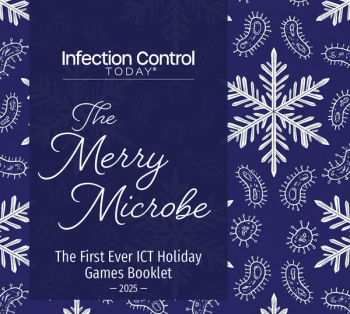
To celebrate and thank the infection prevention community, Infection Control Today® introduces The Merry Microbe, a festive holiday games booklet filled with quizzes, puzzles, and crosswords designed to educate, engage, and bring a little joy to the vital work of keeping health care environments safe.

ICT’s top articles of 2025 spanned essential glove-use standards, CDC guidance on H5N1 monitoring, AI-driven infection prevention in operating rooms, advanced influenza surveillance for public health reporting, and APIC’s warning on communication restrictions that threaten outbreak response. Together, they highlight the evolving, high-stakes role of infection prevention in safeguarding health care and communities.

Good credentials, like a good ladder, make all the difference in how well you do the job you need to do. Read on to find out more about why credentials are vital to be successful.

With the threat of antibiotic-resistant infections rising, hospitals must recalibrate cleaning protocols to maximize people’s health and well-being while continuously mitigating infection risks.


When infection control slips, the consequences can be serious: patient harm, staff illness, fines from OSHA/local inspectors, and damage to your reputation. That’s why training isn’t optional; it’s essential.

Long-term wastewater surveillance revealed hidden SARS-CoV-2 transmission, detected variants early, and supported new EU public health mandates, demonstrating wastewater-based epidemiology as a critical early-warning tool for infection prevention, environmental hygiene, and outbreak preparedness.
A large population study of more than 1,100 adults suggests there are really 2 biologically meaningful nasal states: noses dominated by Staphylococcus aureus and noses ruled by protective commensals like Corynebacterium and Dolosigranulum. Intermittent carriers fall in between, prompting researchers to rethink long-standing categories of S aureus colonisation and risk.

As hospitals search for new ways to reduce environmental bioburden, copper-embedded textiles are emerging as a promising tool. In this second installment of ICT's recent panel discussion, experts described how these soft, everyday fabrics can rapidly kill microbes, sustain their effectiveness between washes, and strengthen infection control bundles across care settings.
From hospital beds to privacy curtains, textiles may be one of the most underestimated contributors to health care-associated infections, according to experts who say these everyday items deserve far more attention in prevention bundles.

Missed opportunities, Graves warned, place patients at risk. Many surgical patients are immunocompromised, and a stethoscope may come near the incision. “Regardless of the scenario, [cleaning the stethoscope] each time is going to protect patients.”
Stethoscope hygiene, UV technology, and dwell time failures took center stage in this second installment of a panel of experts explored why routine disinfection still lags and what must change in clinical practice.
Advertisement
Advertisement
Trending on Infection Control Today
1
Bug of the Month: The Quiet Guest in the Dust
2
Manual Cleaning vs Automation: Achieving Consistent Cleanliness for Ultrasound Device Reprocessing
3
Continuous Photohydrolysis Disinfection Cuts MDROs, COVID-19, and Hospital Transfers in Long-Term Care, Study Finds
4
What Is Effective Preparedness for Emerging Respiratory Viruses? Shazia Irum, MSC, MBA, RN, CIC, CPHQ, FAPIC, answers
5
